

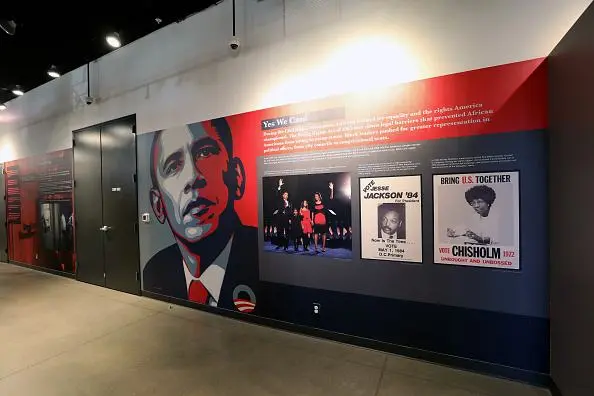
The 'Yes We Can' exhibit, which features Barack Obama's run for Presidency is on display inside America's Black Holocaust Museum, photographed during the 16th Annual 'Doors Open Milwaukee' in Milwaukee, Wisconsin on September 26, 2026. (Photo By Raymond Boyd/Getty Images)
Racial inequalities persist. A constitutional amendment denying it won’t help

There will be three confusing questions on your ballot this year. The important thing to know is to vote NO.
The questions, if approved by a majority of voters, would become constitutional amendments. The measures passed the Republican-controlled state Legislature in two consecutive sessions and now it goes to the voters.They really are turnout mechanisms against Democrats more than anything else.
They are worded in a way to make many feel as though you approve, but it’s deception. If approved, the consequences would be dire and any opportunity to overturn could be limited.
The three measures address the governor’s authority, freedom to gather in places of worship during an emergency and a monumental roll back of a racial reality.
The Milwaukee Courier, Wisconsin’s oldest Black newspaper, encourages residents to vote NO on all three questions.
The exact wording of Question 1 is: “Shall section 10 (1) (c) of article V of the constitution be amended to prohibit the governor, in exercising his or her partial veto authority, from creating or increasing or authorizing the creation or increase of any tax or fee?”
Republicans are upset that Gov. Evers used his veto pen during the 2023-2025 budget to raise school revenue limits every year for the next 400 years. The Wisconsin Supreme Court’s liberal majority upheld the veto.
Republicans have falsely claimed the veto raises property taxes for 400 years, but it actually raises annual revenue limits, not a specific tax or fee.
State lobbying records show the Wisconsin Education Association Council, the state’s largest teachers union, and the League of Women Voters registered in opposition to the question, while conservative business groups are opposed.
The exact wording of Question 2 is: “Shall section 18 of article I of the constitution, which deals with religious liberty, be amended to prohibit the state or a political subdivision of the state from ordering the closure of, or forbidding gatherings in, places of worship in response to a state of emergency, including a public health emergency?”
This stems from lockdown orders by Evers during the COVID-19 pandemic to help stop the spread of the virus. Republican lawmakers believe places of worship should be exempt while ignoring the science.
The amendment is likely a turnout mechanism to mobilize people based on anger over the handling of the pandemic.
Also, the Wisconsin Supreme Court in 2020, under a then-conservative majority, ruled that places of worship were exempt from COVID regulations anyway and it hasn’t been challenged since. So, it’s unclear what the purpose of the question is.
The League of Women Voters opposed the constitutional amendment, according to state lobbying records, while conservative religious groups are in support.
The exact wording of Question 3 is: “Shall section 27 of article I of the constitution be created to prohibit governmental entities in the state from discriminating against, or granting preferential treatment to, any individual or group on the basis of race, sex, color, ethnicity, or national origin in public employment, public education, public contracting, or public administration?”
To be clear, this question is a clear attack on diversity, equity and inclusion — or DEI — policies and how the state government views racial realities in America.
The American Civil Liberties Union of Wisconsin and the League of Women Voters opposed the constitutional amendment during the legislative process, according to lobbying records, while a conservative law firm is opposed.
Jeff Mandell, general counsel at Law Forward, spoke at length about the problems with Question 3 in an interview with the Courier. Law Forward is a Madison nonprofit that focuses on preserving voting rights, ensuring fair elections, and countering legislative overreach or anti-democratic measures in Wisconsin.
“The amendment purports to bar discrimination in government function, and what’s confusing about that is everybody likes that idea, right?” he said. “Nobody thinks we should discriminate. It also suggests that we currently do discriminate or that it’s not already illegal for the government to discriminate. But of course it is illegal because of state and federal constitution provisions and laws.
“Really what the purpose of this amendment is to stop the government from considering the reality that we all know, which is that our society remains unequal as a result of our history and policy decisions that have been made in our state and country across time.
“This amendment would put in our constitution that we have to deliberately bury our heads in the sand and refuse to confront those realities. And it would make any attempt to confront those realities a violation of the state constitution, which is deeply problematic.
“We have the largest racial achievement gaps in the country in our public schools. We have significant racial gaps in health outcomes in this state. And when we continue to see significant economic gaps that trace along racial lines too often. We should keep in our toolkit for our government, programs that in very targeted, specific, fact-based ways work to improve and equalize our society by ameliorating some of these gaps that stubbornly persist. And this (amendment) would end that and it would end that as an option for policy makers.
Mandell notes that these efforts, in many ways, are in response to DEI efforts implemented after the Black Lives Matter movement and the murder of George Floyd. But Mandell said lawmakers have long before addressed racial realities through legislation.
“I think it's related to all of those things,” he said. “And I think it's also largely an effort to motivate and turn out folks to the polls who are deeply concerned about DEI, or DEIA, efforts.
“But, the reality is that a lot of this is just based on misinformation. For example, Wisconsin has a minority business enterprise program that was created in the '80s because the Legislature found that minority-owned businesses were not getting an expected share of public contracts.
“Public contracts in the state of Wisconsin are more than $3 billion a year. So, the idea was that the state was going to create a program that would try to help diversify which suppliers were receiving these contracts and were therefore receiving taxpayer money. This is not a quota system. This is not an effort at what some people would think of as reverse discrimination or anything like that. And yet, we're more than 40 years into this program and the statistics show that still, we have significant barriers to equal participation.
“The most recent year that I've seen statistics show less than 6% of that contract value went to minority-owned businesses. But minorities are a much larger percentage of the population in Wisconsin than 6%, and minority owned businesses are a larger share of our local business communities than 6%.
“So there's clearly something that's persisting and that's going wrong and the solution to that is not to put it in the Constitution that we simply have to pretend that everything is as great as it can possibly be. The solution to that is to allow policymakers to continue to have the ability to look carefully at what's happening and to solve the problems in our communities.”
Drake Bentley is the general assignment reporter for the Milwaukee Courier, covering politics, sports and the community. He is an award-winning investigative journalist who has worked for the Milwaukee Journal Sentinel, Wisconsin State Journal, Newsweek, Heavy and The Sporting News. He is a northside Milwaukee native, former political staffer and graduate of the University of Wisconsin-Whitewater and the University of Nebraska.