

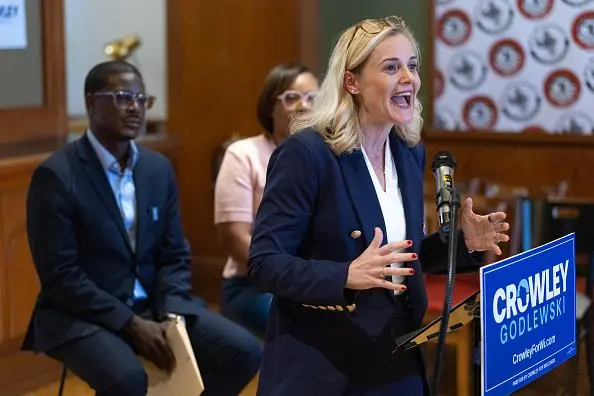
MILWAUKEE, WISCONSIN - OCTOBER 06: Wisconsin Democratic gubernatorial candidate David Crowley listens as his running mate, candidate for lieutenant governor Sarah Godlewski, outlines their stance on reproductive healthcare rights duting a campaign event at Turner Hall on October 06, 2026 in Milwaukee, Wisconsin. Crowley is running against Republican Tom Tiffany. (Photo by Scott Olson/Getty Images)

Sarah Godlewski, David Crowley’s running mate for Wisconsin governor, has long been committed to bettering underserved communities and her work is specifically rooted in helping Black women.
The 44-year-old Eau Claire native is seeking to become the first woman to lead three statewide offices in Wisconsin. Prior to leading the state department, she was state treasurer from 2019-2023.
The position of lieutenant governor isn’t necessarily the most constitutionally impactful position. But the person is second in command to the state government, where Godlewski is very comfortable.
The Milwaukee Courier, Wisconsin’s oldest Black-owned newspaper, is proud to endorse Godlewski for lieutenant governor for this midterm election.
Here is a Q&A with Godlewski from earlier this month that has been lightly edited for clarity.
The position of lieutenant governor is kind of viewed in the same kind of vein as vice president, where it's not necessarily the most constitutionally impactful job. But how do you see your role in a Crowley administration, especially when Crowley has said he intends to bring more people to the table and he'll defer to others?
I think for starters, I would argue that being the second-in-command for a state of 5.8 million people is pretty significant. But that said, one of the things that I believe I've always brought to the table with my constitutional offices is folks have told me that the treasurer couldn't do anything, that the secretary of state couldn't do anything, and I truly believe it's always about the person. It's not about the position. And so when you look at my record as state treasurer, despite the Republicans turning off my Wi-Fi and giving me a pay as you go flip phone as a way to conduct work in my office, I still provided record breaking distributions to public schools and created a foreclosure prevention fund to keep people in their home. And so that's why I ran for this position, because I wanted to deliver for Wisconsin. And what I'm so excited about is how David wants that partner. He wants somebody, because he understands and realizes that rising tides raises all boats, and the more people working together to help make Wisconsin more affordable and better for working people in our state, the better we all are. In many conversations with David, he has been very clear with me that he looks at me as a partner, and the work that we are going to do together. And I think it couldn't be more different than when you look at Tom Tiffany and David Varnum. I mean, you don't see David Varnum on Tom Tiffany's signs. They're not doing joint press conferences together. They're barely doing joint events. And I think Wisconsinites should ask why. For instance, David Crowley, we are everywhere together, and we're traveling the state, and we're showing this unified ticket because that's who David is. He knows we're better when we all work together, and I can't wait to work with him on our affordability agenda.
If you’re elected, which issues would you want to take the lead on?
For me, my background's in economic security. I got involved in politics because I found out that the amount of money Silicon Valley was getting in one day when it comes to supporting small businesses is what Wisconsin was getting in an entire year. And I know that we run on Main Street, not on Wall Street. And that's why I ran for state treasurer and I would want to kind of continue that work. I mean, we're right now seeing that Wall Street incorporations are getting a free ride, whether it's from some of the largest tax breaks we're seeing at the expense of small businesses. And we run here on small businesses. Also, buying Wisconsin products. We have seen under Tom Tiffany that our largest trading partner, Canada, has been under attack because he has agreed to and did not stop tariffs with Canada. And I believe that we need to be doing everything we can do to be supporting our farmers, to be supporting our economies here that are really feeling the squeeze. And so, to me, that would be everything from making sure that we're supporting our small businesses. We are working on affordable quality childcare. That has been a big thing as a working mom myself to a 6-year-old, the fact that childcare now costs more than the tuition at the University of Wisconsin is horrifying. And so I would really want to focus on that economic security, which would help bring good paying jobs, and making sure folks who work hard can make a fair wage and can not just survive but can thrive here, and can raise a family and earn money to retire with dignity. Like we don't even have a public retirement plan here that people can buy into. And so, as we have one of the fastest aging populations in the state, we've got to make sure our seniors are taken care of, and so for me, this is all under a larger kind of economic security bucket.
Wisconsin has made a lot of women the first to accomplish something, whether that be Tammy Baldwin, Gwen Moore, Vel Phillips, or more recently, flipping the state Supreme Court. Do you believe there is a role for a woman’s voice, or a mother’s voice, during these times?
We've never had a woman elected to three different constitutional offices, so that's history in a unique way, and I think using that perspective is really meaningful. I mean, I have now lived in the state at a time when Roe was overturned and I saw that I had fewer rights than my mother and my grandmother. And I don't want to be constantly living on the edge based on who is in office, is my reproductive freedom going to be protected? To me, it's very clear, reproductive freedom belongs to women and their doctors, period. And that is something that David and I have talked a lot about. We did a joint press conference about how we want to work with the Legislature to enshrine reproductive freedom into our Constitution. So, folks like Tom Tiffany, who wants a complete abortion ban, which couldn't be more extreme, because he doesn't want any exceptions, not even for rape, incest, or the life of a mother. And we don't want women living on the edge. We want them to be able to make those very private medical decisions with their doctors. And so, I think there's absolutely an important role that needs to be played. And look, there's more we could be doing equal pay as an example. Women still don't make the same as men. We know that Black women in particular make about 68 cents to the dollar. And so there's a lot of different ways that we need to be working towards a mom’s voice that can really help be a partner with David in governing the state.
You've been both Secretary of State and Treasurer. What exactly do these offices do and what are your accomplishments there?
I look at the treasurer and the way that the office was envisioned by our founding fathers here in Wisconsin is that they would be the chief financial officer of the state. In that mindset as state treasurer, I oversaw a $1.6 billion trust fund that benefited public schools. And one of the things that I worked on was making sure that we increased our distributions to public schools because we have been seeing referenda after referenda that are really hurting our schools. Kids are getting less, teachers are being asked to do more. And that's not right. And so, as state treasurer, we increased distributions every single year that I oversaw the $1.6 billion trust fund, and it wasn't just an increase. Every single year it was a record breaking distribution. And that makes a real difference. One of the things that we were able to do was during COVID, when we saw folks didn’t have access to the internet, we provided a special distribution for schools to address the digital divide. The other big piece is that we know how folks build wealth and build communities? It's through homeownership. Wisconsin is the third worst state for Black home ownership, and we are behind the national average when it comes to first time homeowners. And so I started a homeownership task force, and one of the initiatives out of that was something called Take Route Wisconsin that was working with folks to help them buy, save and stay in their homes. In addition to that, we know that seniors are on fixed incomes and they were seeing an increase and we wanted them to stay in their home, so we created a property tax foreclosure prevention fund to help keep folks in their home. I led a retirement security task force where we created legislation that actually got a hearing that was bipartisan. Which in Wisconsin, sometimes it's unheard of. We created this program called 401 Kids that would get every kid in the state of Wisconsin a savings account and they then could use that money because it would be invested to buy a home, start a business, or go to school. And so these are just a few of the kinds of initiatives we put forward. And then as Secretary of State, I view that position as almost like the chief operating officer for this state. And so it's responsible for records. It's responsible for recording work that the Legislature is doing and laws that are passed, executive orders from the governor. So it's a lot of that kind of operating aspect of state government. But the other thing that's kind of unique about the Secretary of State is some people think of the Secretary of State internationally. And we are the only office that can authenticate international cases that need authentication for if you ever want to open a business overseas or if you ever want to adopt a child, or study abroad, and we see thousands of cases per year. But before I got there, you couldn't even pay for our services using a credit card. It was either cash or check. And so one of the major initiatives that I did was not the sexy things that people think government is about, but I think is really important, is we work to make sure those services are accessible. So regardless of where you lived, now you can make requests online. We take digital payments. We digitized thousands of records that are now accessible to the public. We increased our security because we have a lot of private and sensitive information. You can’t operate well if you don't have good security, if you don't have transparency and if you don't have accountability.
Crowley has proposed more transparency in state government. Are you committed to the same?
I think David and I share this common value, where good government is transparent government. And it's one of the things that I did as state treasurer. I actually created a taxpayer transparency report, where with every biennium budget, we made sure that it was a reader's digest version because as much as people want to read 1500 pages of budget information, that's not really digestible for busy Wisconsinites who are working jobs, taking care of kids, or their parents and so, we put together a taxpayer transparency report to make sure people could have that information and know where their tax dollars were going. And so I think with David's transparency plan, that's exactly what he is really believing in is this kind of value that government shouldn't be in a black box somewhere. We want to make sure people have access and know where their money is going to and why. To me, that is the purpose and mission of that larger transparency plan.
Can you discuss your philanthropic work over the years particularly benefiting Black women?
What led me to even getting involved in finance in the first place was where it all started, which was microfinance. And I got started in microfinance, particularly I was focused on access to capital for women and communities of color, because we know that the system is not built for these inequities. And you know Black women in particular are often left behind. I mean there are billions of dollars in the startup community, and despite being one of the fastest growing groups of entrepreneurs, they get less than 1% of the billions of dollars. These women are then stuck putting this, these businesses they want, these dreams, which I think is part of what we dream of in America, they have to put it on their credit card paying 26% interest, and that's not realistic. In helping with access to capital, I saw that these women and communities of color were not just using it to start their businesses, their businesses were then so successful, and then they were taking that success and transforming their entire communities. So to me, that was really just motivating and encouraging. And then from there, I got involved with UNICEF. I was working as a board member with UNICEF, when we were working in a lot of different countries, but particularly with access to healthcare, because we know that if folks don't have access to basic care, they can't have a job or learn. And then in addition to that building school, because folks wanted more and they wanted opportunities, but they knew education was a critical piece to that. So that is kind of where my philanthropy work started, it's actually where I met my husband. I really believe deeply in that kind of work and giving back to the community. And really seeing that the system is not built that's fair was what got me to run for treasurer in the first place.
Drake Bentley is the general assignment reporter for the Milwaukee Courier, covering politics, sports and the community. He is an award-winning investigative journalist who has worked for the Milwaukee Journal Sentinel, Wisconsin State Journal, Newsweek, Heavy and The Sporting News. He is a northside Milwaukee native, former political staffer and graduate of the University of Wisconsin-Whitewater and the University of Nebraska.