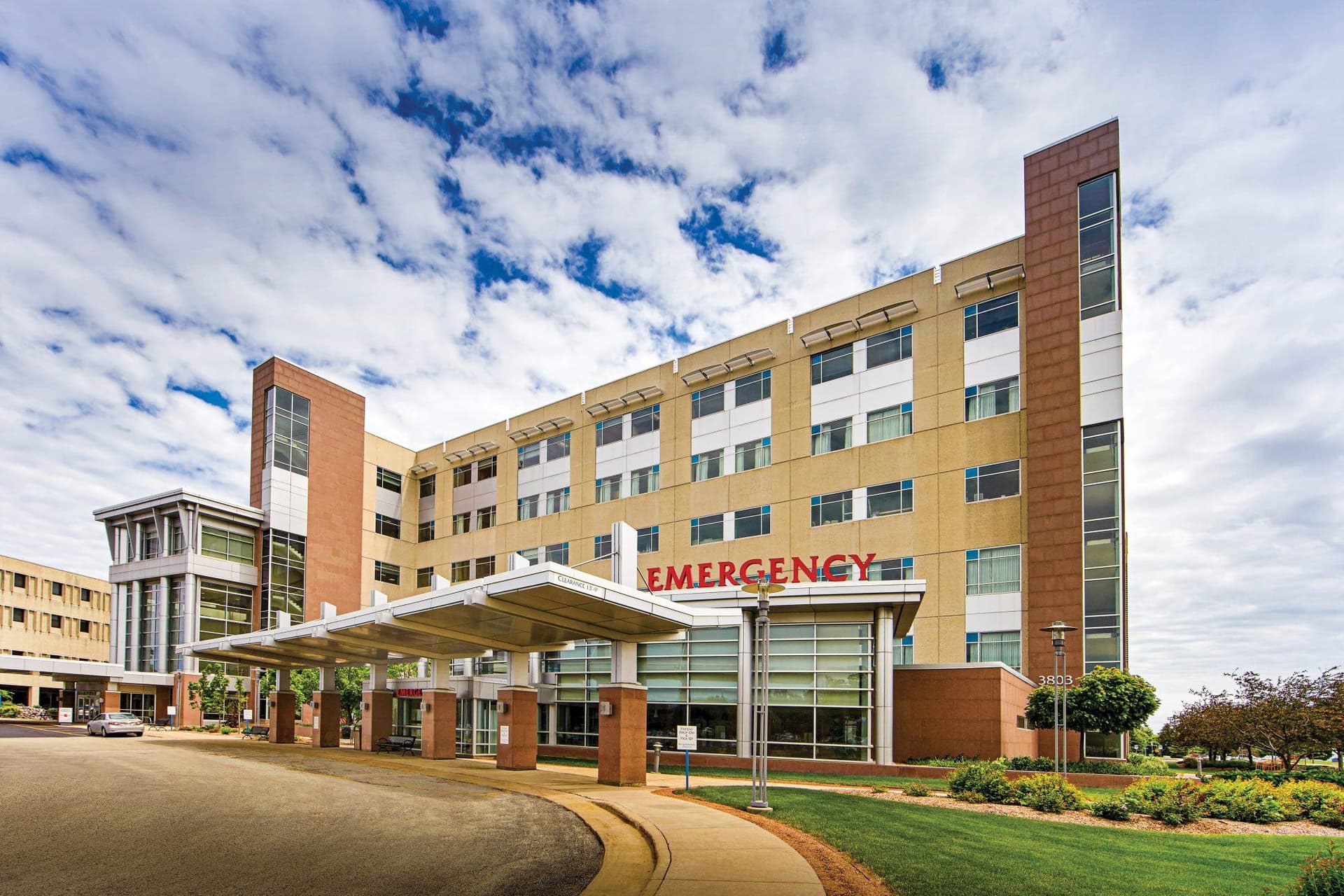
All Saints gained $176 million from Wisconsin’s hospital tax. It admits more than a third fewer patients
Racine’s only general hospital came out $176.4 million ahead under the state’s hospital tax over eight years. State law doesn’t require it to report what the money pays for. Part of Racine County Eye’s Who Pays for Medicaid series.
In short:
Ascension All Saints Hospital came out $176.4 million ahead under Wisconsin's hospital tax from July 2017 through June 2025, more than any other Racine or Kenosha County hospital. Over the same years it admitted 38% fewer patients, cut staff and moved inpatient psychiatric care to Milwaukee. The 2025-27 budget tripled the tax and the payments it funds; state law puts no conditions on how hospitals spend the money, and federal cuts begin in 2028.
Racine’s only general hospital came out $176.4 million ahead under Wisconsin’s hospital tax in the eight state budget years from July 2017 through June 2025, more than any other hospital in Racine or Kenosha counties, Department of Health Services reports show. In 2024-25, only two hospitals in Wisconsin came out further ahead. Since 2019, Ascension All Saints Hospital has admitted 38% fewer patients, and Ascension now sends Racine patients who need a psychiatric bed to Milwaukee.
The tax pays the most to hospitals that treat the most Medicaid patients, and All Saints has the highest Medicaid share of any local hospital: Medicaid made up 24.7% of what it billed patients in fiscal 2024, according to the Wisconsin Hospital Association’s Guide to Wisconsin Hospitals, a figure Ascension confirmed to Racine County Eye. In 2024-25, under the old, smaller tax, All Saints paid $5.13 million and got $23.48 million back in added Medicaid payments, about $4.58 for every $1, state records show. Aurora’s hospital in Burlington, which treats fewer Medicaid patients, paid $2.8 million and got $1.4 million back.
Now the payments are far larger. The 2025-27 state budget more than tripled the tax: All Saints’ bill rose from $5.13 million in 2024-25 to $17.82 million in 2025-26, according to state assessment schedules. Statewide, hospitals now pay about $1.51 billion a year instead of about $420 million and receive about $2.01 billion more a year in Medicaid payments, $1.22 billion of it federal, according to the Legislative Fiscal Bureau’s budget summary.
Ascension says the money helps but does not close the gap. The larger hospital tax “helps Ascension All Saints Hospital and other safety-net facilities reduce shortfall gaps,” an Ascension Wisconsin spokesperson said in a statement, but “a sizable margin of unreimbursed care remains for our hospitals to absorb.”
The question for Racine is whether that money keeps care here. All Saints still handles a lot of emergencies: 46,755 emergency room visits in the year ending June 2025, according to its federal tax filing. But it admitted 8,082 patients that year, down from 12,995 six years earlier, according to its Medicare cost reports.
Aurora picked up much of that business. Every one of Wisconsin’s eight hospital regions grew more concentrated from 2018 to 2025, but Racine went the other way: researchers Ike Brannon and Anthony T. Lo Sasso called it “a rare de-concentration” in an Oct. 13 report for UW-Madison’s Center for Research on the Wisconsin Economy. Aurora, “already present with 18 percent of Racine-area discharges in 2018, grew to 35 percent by 2025, while Ascension’s leading share fell from 71 to 51 percent,” they wrote.
The report counts only overnight hospital stays, not outpatient visits or surgery centers, so it cannot test Ascension’s explanation that more care has moved to outpatient settings.
What the money pays for is not public. Under the hospital tax statute, state law imposes no conditions on how hospitals spend it and requires no reporting. The payments are a uniform increase and aren’t tied to any hospital’s results.
There is also a timing gap. Every measure of All Saints’ decline in this story ends in June 2025, the day before the larger tax and payments took effect. The new money at All Saints will not appear in public records until the state’s next hospital reports and the hospital’s next federal tax filing.
The state has not yet published what All Saints has received under the larger tax, and the Department of Health Services has not yet provided the figures Racine County Eye requested Sept. 26. Racine County Eye has also asked the department whether it tracks how hospitals use the money. Starting in 2028, federal law begins cutting payments.
What this means for you
- Emergencies: All Saints’ emergency room in Racine is still open. In an emergency, call 911.
- Psychiatric care: Patients who need to be admitted for psychiatric care are now sent to Ascension St. Francis Hospital in Milwaukee. Ascension says it still offers outpatient counseling, psychiatry appointments, and adolescent day treatment in Racine.
- Mental health crisis: Racine County’s Behavioral Health Building on Taylor Avenue is scheduled to open Nov. 2 with a walk-in crisis center. You can also call or text 988, the national Suicide & Crisis Lifeline.
- Can’t pay a hospital bill? All Saints offers free or discounted care to eligible patients. Apply at healthcare.ascension.org/financial-assistance.
The money, year by year
How the hospital tax works, step by step: Racine County Eye’s explainer.
The state reports each hospital’s numbers to lawmakers every year. All Saints’ yearly gain shrank from $25.5 million in 2017-18 to $18.4 million in 2024-25, about $50,000 a day, as it treated fewer Medicaid patients, according to the Department of Health Services. The most recent report, released Oct. 16, still covers the year before the tax increase; the department says future reports will include figures under the new law.
| Hospital, 2024-25 | Tax paid | Added Medicaid payments | Came out ahead (or behind) |
|---|---|---|---|
| Ascension All Saints, Racine | $5.13M | $23.48M | +$18.35M |
| Aurora Kenosha and Mount Pleasant (reported as one hospital) | $7.62M | $11.66M | +$4.04M |
| Froedtert South, Kenosha | $6.16M | $8.91M | +$2.75M |
| Lakeview Specialty Hospital, Waterford | $0.27M | $0.40M | +$0.13M |
| ClearSky Rehabilitation Hospital, Kenosha | $0 | $0.10M | +$0.10M |
| Aurora Memorial, Burlington | $2.80M | $1.38M | −$1.42M |
| All Wisconsin hospitals | $414.5M | $672.0M | +$257.5M |
Asked what All Saints paid and received, Ascension spokesperson Mo Moorman wrote Oct. 2 that “this information is not publicly available.” The state’s annual reports do make the figures public through June 2025. Asked again Oct. 19 what All Saints received in 2025-26 and what it has done with the money, Moorman wrote Oct. 23 that “this financial data is not yet publicly available.”
Ascension’s statement said Medicaid in Wisconsin has historically covered only 66% of hospitals’ care costs, and that Medicaid paid for 22% of All Saints’ care in fiscal 2025 and Medicare paid for 50%, by the hospital’s payer mix. All Saints’ own federal tax filing shows that gap: in fiscal 2025, the hospital spent $71.5 million caring for Medicaid patients and was paid $50.9 million, a $20.6 million loss. Ascension Wisconsin is investing more than $200 million in its hospitals and care sites through 2028, including more than $25 million at All Saints for incubators, surgical equipment, patient beds, stretchers, imaging equipment and upgrades to elevators and lobbies, the statement said.
The hospital’s own filing gives one measure of care for patients who can’t pay. In fiscal 2025, All Saints reported $10.0 million in charity care at cost, free or discounted care for low-income patients, or 2.9% of its expenses, according to its federal tax filing. It reported $37.5 million in total community benefit, a broader figure that also counts what it lost treating Medicaid patients. The filing does not tie either figure to the hospital tax.
Some money also moves within Ascension. In fiscal 2025, All Saints transferred $22.9 million in cash or property to its parent, Wheaton Franciscan Healthcare–Southeast Wisconsin Inc., the Ascension corporation that controls it, according to the same filing. Although the hospital finished the year $6.1 million ahead, the transfer helped shrink its net assets from $212.9 million to $196.1 million. The filing also lists a $40.7 million “management fee to affiliate,” mostly counted as administrative cost, without naming the affiliate or saying what the fee covers. Asked Oct. 20 what the transfer was for and what the fee covers, Ascension did not answer.
Federal rules require the state to show the payments advance a goal in its Medicaid quality plan. In its 2026 application, Wisconsin named one goal, to “maintain or improve provider participation in Wisconsin Medicaid for key provider types,” and four statewide measures, including whether patients get follow-up care within 30 days of a psychiatric hospital stay and how often patients land back in the hospital. When federal regulators approved the payments on May 15, they required the state to change its 2027 evaluation so the measures cover only the hospitals and Medicaid health plans in the arrangement.
The state also gets no advance word when hospitals merge or change hands. “Wisconsin does not require prior notice to the state of pending health care transactions,” the UW-Madison researchers wrote. The Legislature’s Joint Committee on Finance removed an advance-notice provision from the state budget in May 2025, they noted. Illinois has required 30 days’ notice since 2024.
Is All Saints shrinking?
On an average day in fiscal 2025, about 41% of All Saints’ beds were filled, down from about 61% in fiscal 2019, and its staff fell from the equivalent of 1,388 full-time workers to 1,126, according to its Medicare cost reports.
Aurora’s gain did not start with its new hospital. The erosion of All Saints’ share “began before Aurora’s Mount Pleasant hospital opened and continues after it, so the new facility accelerated a shift already underway rather than initiating one,” the UW-Madison report found.
All Saints’ revenue has shrunk, too. It reported $408.6 million in revenue on its IRS Form 990 for the fiscal year ending June 2016, the year Ascension took over, and $355.0 million in fiscal 2025. On the same filings, it lost $20.0 million in fiscal 2024 and made $6.1 million in fiscal 2025. That year ended June 30, 2025, the day before the higher tax and payments took effect, so the turnaround came before any of the new money arrived.
Where do Racine patients go for psychiatric care?
Ascension has moved All Saints’ inpatient psychiatric care to St. Francis Hospital in Milwaukee, under a plan it announced in November 2024.
All Saints admitted seven psychiatric patients in June and none in July, while St. Francis admitted 124, according to the Wisconsin Hospital Association’s July 2026 utilization report. Ascension said it moved all inpatient behavioral health care to St. Francis by June 30, 2026. In Racine, All Saints still offers outpatient behavioral health counseling, adult and child/adolescent psychiatry, transcranial magnetic stimulation, Spravato treatment, its Women of Worth program and adolescent day treatment, Ascension said. It did not say how many beds the Racine unit had.
Racine County is trying to fill part of the gap with a $34.45 million Behavioral Health Building on Taylor Avenue, scheduled to open Nov. 2, with a walk-in crisis center, round-the-clock crisis services and a 15-bed addiction treatment program, but no inpatient psychiatric beds. Health officials said the building will take referrals from Ascension and Aurora hospitals. Until now, sheriff’s deputies have often driven people in a mental health crisis to the state’s Winnebago Mental Health Institute, near Oshkosh, where the county pays $2,383 a day, county officials said.
“There are times that our deputies sit with a person for hours before they can be cleared, and once they are cleared, they have to be driven sometimes to Winnebago,” Racine County Sheriff’s Office Capt. Cary Madrigal, the Republican candidate for sheriff, said at the building’s Oct. 21 ribbon cutting. “That is a huge cost to taxpayers,” she said, because each emergency mental health detention takes two officers, for the drive and for the wait at the hospital.
“People can stay where they live. They can stay with their family support system and also receive the essential services they need,” said Pat Bohon, board president of NAMI Racine County, the local chapter of the National Alliance on Mental Illness.
All Saints has 330 licensed beds and currently staffs about 130, Ascension said. It attributed the drop in inpatient stays to “the national healthcare trend of delivering more care in outpatient settings.” Its intensive care unit has in-person coverage by ICU providers around the clock, and its gastroenterology, urology, nephrology, dermatology, and plastic surgery doctors are independent physicians, not All Saints employees, which is why they don’t appear in All Saints’ Medicare billing data, Ascension said. It did not say which specialty groups have stopped seeing patients in Racine since 2022, or where those patients now go.
The hospital association’s data offer a partial check on that explanation. In fiscal 2024, All Saints logged 387,281 outpatient visits (excluding emergencies), up 4% from the year before, while emergency visits fell 3% to 47,321 and outpatient surgeries fell 8% to 3,567, according to the Guide to Wisconsin Hospitals. The guide compares only those two years.
Some campus care has shifted to other operators. On Jan. 1, 2026, Ascension’s GI clinic care shifted to the independent GI Associates and moved to Sturtevant, while emergency and inpatient GI consults stayed at All Saints, Racine County Eye reported. Racine Outreach Community Health Centers opened a clinic on the All Saints campus in January 2026.
Aurora grew in Mount Pleasant
Aurora Medical Center–Mount Pleasant opened in February 2022 with 60 beds, including 12 intensive care beds, five operating rooms and an emergency department, according to Aurora’s Feb. 2, 2022, announcement.
Aurora Mount Pleasant reported $16.3 million in net income on $121.4 million in total revenue in fiscal 2024, according to the hospital association’s guide. All Saints lost $20.0 million that year, according to its IRS Form 990; the guide, which counts hospital finances differently, shows a larger loss. The association says the guide reports each hospital’s financial figures separately and does not allocate them across health systems, and that Aurora Mount Pleasant’s numbers reflect that facility’s data even though it shares a Medicare provider number with Aurora Kenosha.
What happens when the money shrinks in 2028?
The new money also has an end date. Under the 2025 federal budget law, states like Wisconsin that did not fully expand Medicaid must cut the extra payments Medicaid health plans receive by 10 percentage points a year starting in 2028, until they fall to 110% of what Medicare pays, the Wisconsin Hospital Association told federal regulators.
How fast that happens is still being decided. The association’s preliminary modeling shows the cut could take six years under the method federal regulators proposed in May, versus 11 years under an alternative. The association has no dollar estimate yet; it said Oct. 23 it is waiting for the federal final rule’s method. It has asked the Centers for Medicare & Medicaid Services to let states choose.
The state’s first dollar estimate came in the Department of Health Services’ Sept. 15, 2026, budget request. It lowers the hospital payments funded by the tax by $54.5 million in 2027-28 and $145.2 million in 2028-29, citing the federal limits, and projects the tax will bring in $1.44 billion and $1.32 billion in those years, down from $1.51 billion now. It does not break the figures out by hospital.
Hospitals are lobbying to stop it. “We’ll be working to build support in Congress to prevent those scheduled reductions,” Christian Moran, the Wisconsin Hospital Association’s senior vice president of finance and payment, told Racine County Eye reporter Grant Ritchey in a July 6 interview.
U.S. Rep. Bryan Steil, R-Janesville, called the new money “a billion-dollar increase” at an Oct. 17 campaign stop in Mount Pleasant. Racine County Eye’s fact-check found the figure holds up but leaves out who pays for it and the 2028 cut.
Asked about All Saints’ plan for 2028, when the payments begin stepping down, Ascension said it will “continue to collaborate with the county and partners such as Outreach and their Federally Qualified Healthcare Center (FQHC) at the All Saints Spring Street campus to help coordinate care,” and that it has given $1 million to that health center. It did not say how All Saints would make up for the smaller payments.
Disclosure: Ascension Wisconsin advertises with Racine County Eye. Ascension had no role in the reporting or editing of this story.
Why we’re covering this
Wisconsin’s expanded hospital tax shifts more of the cost of Medicaid hospital care to the federal government, and All Saints, Racine’s only general hospital, gains the most locally. The state publishes what each hospital pays and receives, but not what the money does for patients, and federal law starts cutting it in 2028. Racine County residents deserve to know whether it keeps care in Racine, and what they could lose when it shrinks.
What we know, and what we don’t
We know: how the tax and payments work; that All Saints has the area’s highest Medicaid share; that its inpatient volume, staff and market share have fallen since 2019; that inpatient behavioral health moved to Milwaukee.
We don’t know yet: what All Saints, Aurora or Froedtert South received back under the new, larger tax; what All Saints is doing with the money; which specialty groups have stopped seeing patients in Racine; how the 2028 cut will be calculated.
Who decides what
- Wisconsin Legislature and governor: set the hospital tax and payment pool (2025 Act 15).
- Department of Health Services: sets payment rates under state law, with federal approval.
- Centers for Medicare & Medicaid Services: approves the program each year and is writing the 2028 phase-down rule.
- Congress: set the 2028 phase-down in the 2025 federal budget law.
- Ascension, Advocate Aurora, Froedtert: decide how the money is spent and which services stay in Racine.
What we’ll watch
- The state’s hospital-by-hospital tax and payment records under the new law
- Ascension’s answers on services, staffing and the 2028 plan
- The federal government’s final rule on the 2028 phase-down
- All Saints’ next IRS Form 990, including charity care
Timeline
| Date | What happened |
|---|---|
| Feb. 2022 | Aurora Medical Center–Mount Pleasant opens |
| Nov. 2024 | Ascension announces All Saints’ inpatient behavioral health will move to St. Francis in Milwaukee |
| July 3, 2025 | Gov. Tony Evers signs the 2025-27 budget, raising the hospital tax and payments |
| July 4, 2025 | Federal budget law signed, freezing hospital taxes and setting the 2028 phase-down |
| Feb. 26, 2026 | Federal regulators approve Wisconsin’s 2025 hospital payments |
| May 15, 2026 | Federal regulators approve 2026 payments, with a condition to update the state’s evaluation |
| June 30, 2026 | All Saints’ inpatient behavioral health care has fully moved to St. Francis, Ascension says |
| Nov. 2, 2026 | Racine County’s Behavioral Health Building scheduled to open |
| Jan. 1, 2028 | Federal phase-down of the payments begins |
This story is part of Who Pays for Medicaid, Racine County Eye’s ongoing series on how Wisconsin pays for Medicaid and what the changes mean for Racine County. Also in the series: How Wisconsin’s hospital tax works and where the money goes; Medicaid’s $1 billion boost is real. Hospitals pay the state’s share, and cuts start in 2028; Steil’s $1 billion Medicaid claim holds up. His rural health figure doesn’t; and Wisconsin’s Medicaid budget shortfall and Racine County. Related coverage: Ascension moving Racine mental health unit to Milwaukee (2024); Ascension GI care shifts to GI Associates in Sturtevant (January 2026); Man dies during mental health crisis call at Racine lakefront (July 2026).
AI tools assisted with research and drafting from public documents and Racine County Eye reporting. A human editor reviewed all facts and links before publication.
Sources: Wisconsin DHS hospital assessment reports to the Joint Committee on Finance (P-01210), state fiscal years 2018–2025; DHS/ForwardHealth hospital assessment schedules, state fiscal years 2025 and 2026; Aurora Health Care, Feb. 2, 2022, opening announcement; Legislative Fiscal Bureau summary of 2025 Act 15, Health Services; Wis. Stat. 50.38; CMS approval letter for Wisconsin’s 2025 hospital payments, Feb. 26, 2026; CMS approval letter and Wisconsin’s 2026 application, May 15, 2026; Public Law 119-21; DHS 2027-29 budget request, Sept. 15, 2026; IRS Form 990, Ascension All Saints Hospital Inc., fiscal years 2016–2025; CMS hospital cost reports, provider number 520096; WHA Information Center, Guide to Wisconsin Hospitals, FY2024; WHA hospital utilization report, July 2026; WHA comment letter to CMS, July 21, 2026; Center for Research on the Wisconsin Economy, Hospital Market Concentration in Wisconsin, 2018–2025; Ascension Wisconsin, November 2024 announcement; Ascension financial assistance policy; Ascension Wisconsin emails and statement to Racine County Eye, Oct. 2, Oct. 20 and Oct. 23, 2026; Wisconsin Hospital Association email to Racine County Eye, Oct. 23, 2026; Racine County Eye reporting at the Racine County Behavioral Health Building ribbon cutting, Oct. 21, 2026; Racine County Eye interview with WHA’s Christian Moran, July 6, 2026.