

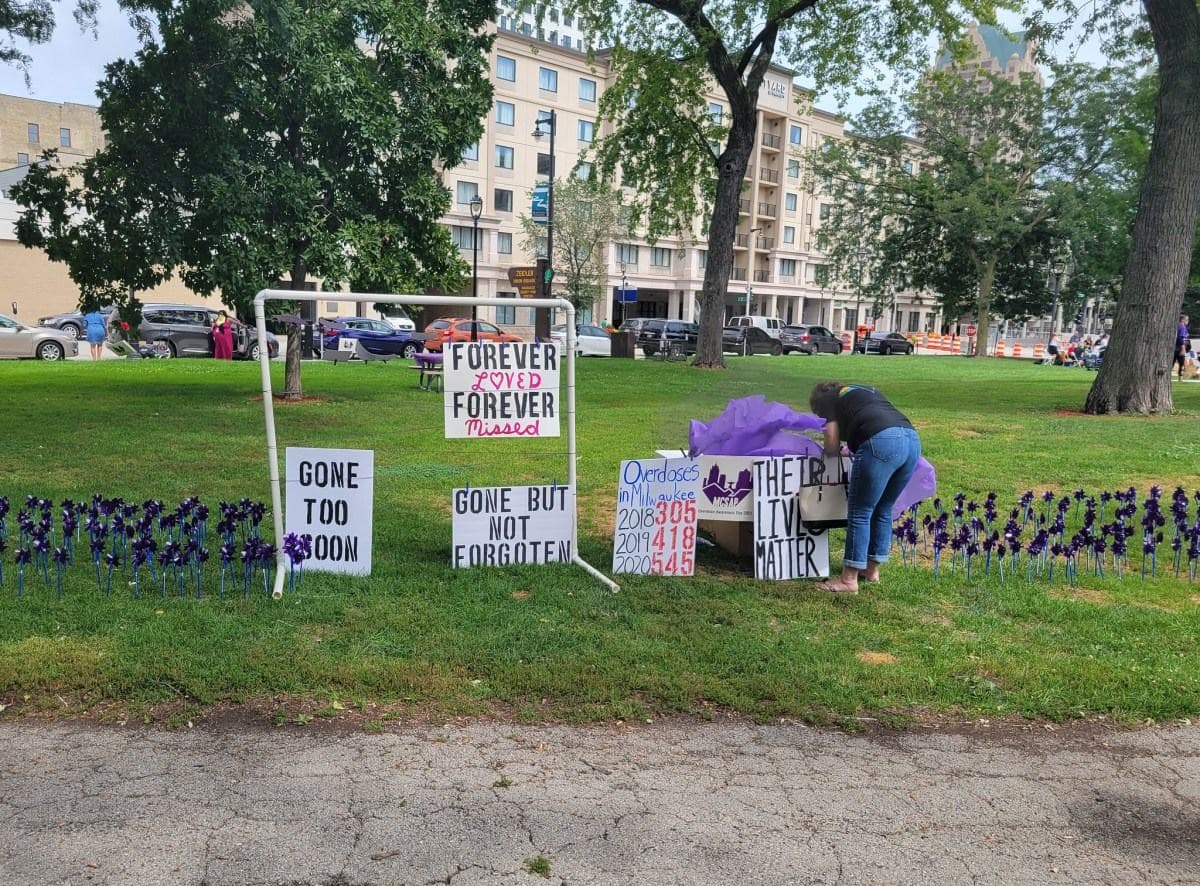


Editor’s note: This story has been updated to include a quote from Tahira Malik, chair of RISE Drug Free MKE.
The first year that RISE Drug Free MKE observed International Overdose Awareness Day in 2017, there were 397 overdose deaths in Milwaukee County. Five years later that number exploded to a record high 674, based on data from the Milwaukee County Overdose Dashboard.
The coalition, which raises awareness on substance misuse, is observing the day of awareness this year with the number of lives lost to overdoses down significantly.
According to data shared by the City of Milwaukee Health Department, unintentional drug overdose deaths declined by 48% from 2022 to 2025, though countywide the decline was 42%.
“The decline in overdose deaths reminds us that compassionate, community-driven action saves lives—but our work is not finished,” said Tahira Malik, Chair of the RISE Drug Free MKE coalition. “Every person deserves to be seen, supported, and given the opportunity to heal. Together, we must continue replacing stigma with compassion, isolation with connection, and loss with hope.”

Local treatment leaders say increased collaboration among stakeholders and an influx of funds from the multi-billion-dollar national legal settlement against opioid manufacturers, which helped fuel the opioid epidemic, have made a difference.

Disparities remain
This year, through Aug. 26, there were 189 confirmed drug overdose deaths with 62 probable cases pending toxicology, according to data provided by Timothy Schabo, operations manager for the Milwaukee County Medical Examiner’s Office. Last year, through the end of August, there were 258 overdose deaths in the county.
Disparities have grown among overdose victims. In 2018, American Indian, African American and Hispanic or Latino groups in Milwaukee combined for 35% of fatal overdoses. So far this year, the groups account for 59% of all overdose deaths.
African Americans have had a higher rate of overdose deaths per 100,000 residents than whites in the county each year since 2021, according to data from the Overdose Dashboard. This year, 48% of confirmed overdose victims were Black, compared with a 39% rate for whites and 10% for Hispanics. According to 2025 estimates by the U.S. Census Bureau, 27% of residents in Milwaukee County are Black, while 61% are white.
An NNS and Wisconsin Watch report found that older Black men, particularly those born from 1951 to 1970, have been most affected by the drug crisis in recent years. Nearly 13% of overdose victims so far in 2026 are Black men from that era.

Kenneth Ginlack, executive director of Serenity Inns, a North Side recovery program for men, said addressing those disparities, even as the overall number of overdose deaths goes down, remains a challenge.
He said part of the problem is that stimulant and methamphetamine overdoses are increasing in Black and brown communities.
“We need to get more education out there to change that,” he said.
Ginlack said another ongoing challenge is stigma and false narratives.
“People think, ‘yeah, I don’t use opioids,’ but they could use cocaine and that is an issue itself,” he said.
More help is on the way.
Earlier this summer, Serenity Inns assumed operations of Vin Baker Recovery, an 8,000-square-foot facility at 4757 N. 76th St. Services provided there include intensive day treatment and outpatient treatment, though the organization plans to build a residential facility upstairs.
They plan to create 14 beds there, increasing the total residential spaces provided by Serenity Inns to 54.
“But the demand is still absolutely outweighing the services available,” Ginlack said.
Updates on other efforts to stem overdoses
Milwaukee County recently launched the Better to Know campaign, which will train 15 community ambassadors to share information and practical resources to prevent overdoses and reduce harm in their communities.
“The initiative is informed by the community members it’s serving and guided by the creative advisory board members’ cultural relevance and cultural impact,” said Africa Lucas, project director of Featuring Our Community’s Untold Stories (FOCUS), a county research initiative leading the campaign, in a press release.
Anyone interested in becoming an ambassador can apply before Sept. 15. Businesses, community centers and organizations can also sign up to be a trusted space that makes educational materials, safer-use supplies or overdose-reversal tools like Naloxone accessible.
In July, the County Board of Supervisors voted to adopt an action report requesting allocation of nearly $7.5 million in opioid settlement funds for eight initiatives aimed at reducing opioid and substance use disorders and expanding treatment and prevention services in fiscal years 2027-2029.
The Wisconsin Department of Health Services is looking for ideas on how the state should allocate its share of opioid settlement funds in an online survey open through Sept. 30.
You can track how different counties in the state are spending their share of funds using this Wisconsin Watch tool.
One of the five priorities outlined in Wisconsin’s newly released Injury and Violence Prevention Plan is unintentional drug overdoses. The five-year strategic plan recommends strategies to reduce violence, such as expanding access to risk reduction and healing resources at every age.
At the national level, the Trump administration’s drug strategy supports addiction recovery and reducing opioid overdoses with overdose reversal medications. However, the Substance Abuse and Mental Health Services Administration has released guidance that indicates funding cannot be used for harm reduction services like sterile syringes or fentanyl testing strips.
In July, President Donald Trump nominated Timothy Westlake, a Wisconsin-based emergency physician, to serve as assistant secretary of mental health and substance use. If the Senate confirms his appointment, he would serve as head of the Substance Abuse and Mental Health Services Administration, where he is currently chief of staff.
Local day of awareness events will take place on Monday, Aug. 31, and include a press conference at City Hall, an awareness walk and a support event for those in recovery or who have lost loved ones to addiction, and a film screening.
International Overdose Awareness Day events in Milwaukee
City press conference: Monday, Aug. 31
There is a press conference scheduled at 10 a.m. on Aug. 31 for International Overdose Awareness Day in the City Hall rotunda, 200 E. Wells St.
International Overdose Awareness Day at Veterans Park: Monday, Aug. 31
RISE Drug Free MKE is hosting an event that marks 25 years of international observance of Overdose Awareness Day from 5 to 8 p.m. at Veterans Park, 1010 N. Lincoln Memorial Drive. The free event is being held in partnership with the Milwaukee Health Department, Milwaukee County Department of Health and Human Services and Milwaukee County Parks, and will include a resource fair, 1-mile community walk, speakers, food, memorial space, candle ceremony and watching the lighting of the Hoan Bridge in purple. Registration is encouraged. More information here.
Serenity Inns screening: Monday, Aug. 31
In honor of International Overdose Awareness Day, Serenity Inns, the North Side treatment center for men, is screening “Tipping the Pain Scale” and hosting a panel discussion from 6 to 8 p.m. at The Times Cinema, 5906 W. Vliet St. Panelists include former Milwaukee Bucks player and treatment advocate Vin Baker, peer support specialists and a family member who experienced the loss of a loved one to overdose. Doors open at 5:30 p.m. Register here. More information here.
“The film challenges us to look at addiction and what the community can do differently,” Ginlack said. “The need to use a systematic approach versus just one person looking to address addiction.”


